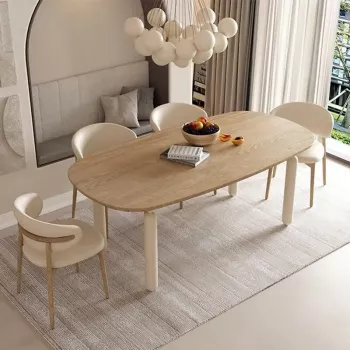
An oval solid wood dining table brings softness and flow to a room while keeping the warmth and durability of real wood at the center of daily life. The curved silhouette makes it easier to move around in tighter layouts, reduces sharp corners in busy households, and creates a natural gathering point for meals, homework, and hosting. If a dining area doubles as a pass-through to the kitchen or living room, an oval top often feels friendlier—both visually and practically—without sacrificing seating.
The best dining rooms don’t just look good—they make people want to linger. An oval shape naturally supports that “stay a little longer” energy while real wood adds comfort that never feels cold or overly formal.
Solid wood also has a reassuring “realness” to it: subtle texture, shifting tones under different light, and the ability to develop character over time rather than simply wearing out.
Two oval tables can have completely different personalities depending on their edge, base, finish, and grain. A few details make a noticeable difference day to day.
For shoppers who care about responsible sourcing, certifications can be a helpful filter. The Forest Stewardship Council (FSC) provides one widely recognized framework for responsible forestry. If you like learning the “why” behind wood behavior—grain, hardness, and natural color—The Wood Database is a practical reference.
An oval table shines when it fits the room’s flow. Before choosing a size, map the space the way it’s actually used: chair pull-out, walking paths, and any nearby doors or cabinets.
| What to measure | Rule of thumb | Why it matters |
|---|---|---|
| Walkway clearance | ≈ 36 in from table edge to wall/furniture | Easier movement and chair pull-out |
| Space per person | ≈ 24 in per seat along the edge | Less crowding at elbows and plates |
| Chair pull-out | Add ≈ 24 in behind chairs | Comfort when sitting down and standing up |
| Rug sizing | Rug extends ≈ 24 in beyond table edge | Chairs stay on the rug when pulled out |
Solid wood is durable, but it isn’t “set it and forget it.” Small habits protect the finish and help the top age gracefully, especially through seasonal humidity changes.
If the dining area is part of an open-plan home, maintaining comfortable indoor conditions can benefit both furniture and people. The U.S. EPA’s indoor air quality overview is a useful starting point for understanding common household factors like ventilation and humidity.
Elegant Oval Solid Wood Dining Table is built around a refined oval silhouette designed to suit both everyday meals and hosted dinners, with the natural character of solid wood. Oval edges help soften the room visually while supporting comfortable movement around the table, and a solid wood top offers durability and long-term maintainability compared with many veneer-heavy alternatives. Availability: in stock.
| Detail | Value |
|---|---|
| Name | Elegant Oval Solid Wood Dining Table |
| Price | 1548.49 USD |
| Stock | 348 |
| Product page | https://azimuna.com/elegant-oval-solid-wood-dining-table/ |
When the dining area is visible from an entry or open living space, a clean-lined storage piece helps the room feel finished—especially for table linens, serving pieces, or seasonal décor. For a modern, art-forward option, consider the Modern Minimalist Ash Wood Wardrobe with Artistic Glass Sliding Doors, which adds vertical presence without competing with the table’s softer shape.
An oval is a 2D shape (a flat outline), not a solid. The closest 3D counterparts are forms like an ellipsoid or ovoid, but an oval tabletop is simply a planar surface cut in an oval perimeter.
Yes—an oval table can improve traffic flow, reduce sharp corners, and fit narrow rooms well while still seating multiple people comfortably. It also supports flexible seating, though it may feel less “edge-defined” for very formal place settings than a rectangle.









Leave a comment