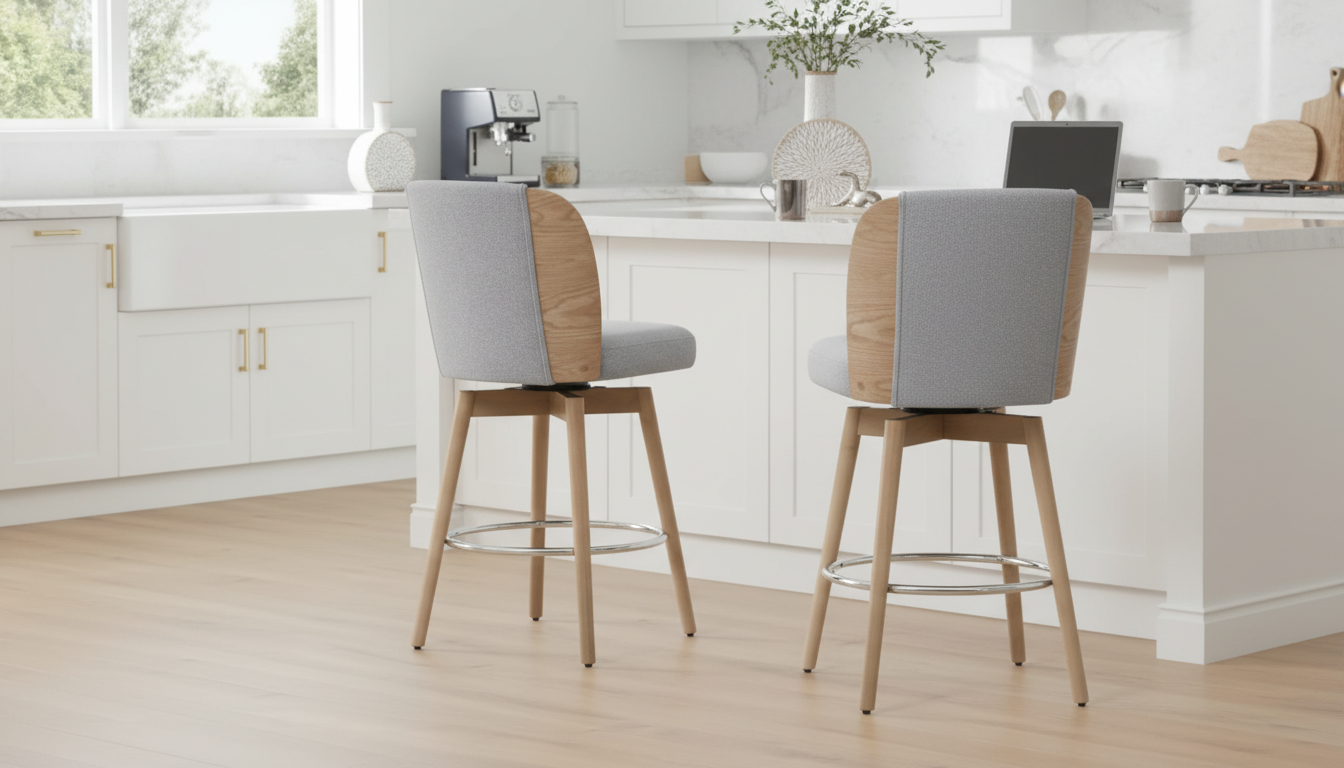
Counter-height seating should feel supportive for long chats, easy to get in and out of, and stable enough for daily use. A well-made set of swivel upholstered stools with backs and wood legs can bring that “pull-up-and-stay-a-while” comfort—without sacrificing the tidy look most people want around a kitchen island or counter. Below is a practical guide to sizing, comfort features, swivel performance, and what to watch for in materials and construction. For more guidance, see These swivel bar stools (set of 2) are the easiest way to refresh your ….
“Counter height” is designed for standard kitchen counters, which are typically about 34–36 inches tall. Before choosing stools, measure from the floor to the top of your countertop, then aim for a seat height that leaves comfortable legroom under the counter.
| Countertop height | Recommended seat height | Comfortable clearance (seat to counter) |
|---|---|---|
| 34 in (86 cm) | 24–25 in (61–64 cm) | 9–10 in (23–25 cm) |
| 35 in (89 cm) | 24–26 in (61–66 cm) | 9–11 in (23–28 cm) |
| 36 in (91 cm) | 25–27 in (64–69 cm) | 9–12 in (23–30 cm) |
Two stools can look similar online and feel completely different at the counter. The difference is usually in the foam, the seat edge shape, and how the backrest supports your torso.
For a quick ergonomic check, sit so your hips are supported, your feet can rest on the footrest without “pointing” your toes, and your back can meet the backrest naturally. General seated-posture guidance like maintaining neutral positions can improve comfort over longer periods (see CCOHS ergonomics guidance).
A swivel isn’t just a “nice-to-have” feature. In real kitchens, it can be the difference between stools that get used and stools that become decorative.
If you’re comparing options, look for a swivel that turns smoothly but doesn’t feel loose side-to-side. That “tight but fluid” feel is often a sign of better hardware fit and assembly.
Wood legs add warmth and a furniture-like finish that can soften the look of stone countertops and stainless appliances. They can also be very stable—if the joints and footrest structure are built to handle daily use.
For households that get heavy use, it’s also worth paying attention to safety and performance expectations for seating. While not all residential stools are certified, understanding furniture performance standards can help you evaluate build quality (see BIFMA standards overview).
If you want a ready-to-go matching pair built for everyday counter seating, consider the Counter Height Bar Stools Set of 2, 360° Swivel Upholstered with Back, Wood Legs. It’s designed to combine swivel convenience with cushioned seating and supportive backs—useful for quick breakfasts and longer hangouts alike.
| Product | What stands out | Link |
|---|---|---|
| Counter Height Bar Stools Set of 2, 360° Swivel Upholstered with Back, Wood Legs | 360° swivel, upholstered seats, supportive backs, wood legs; designed as a coordinated set of two | View product |
Counter height usually pairs best with a 24–27 inch seat height for 34–36 inch counters, leaving about 9–12 inches of leg clearance. Comfort improves with a supportive back, a well-placed footrest, and a cushioned seat with a rounded front edge.
Swivel stools can make getting in and out easier, improve conversation flow, and help in tight layouts because the seat turns instead of the whole stool shifting. Look for a stable base and a smooth swivel that doesn’t wobble.












Leave a comment